U.S. forces intercept and attack the Icelandic rescue team
Operation NapoleonThe U.S. forces’ interception and attack on the Icelandic rescue team turns a secret military exclusion into an armed confrontation on Vatnajökull Glacier. At 2315 GMT on Saturday 30 January, Júlíus led a large rescue party toward a restricted area where Icelanders were believed to be in danger. About twenty U.S. soldiers barred their way; when Júlíus rejected their orders and asserted Iceland’s right to move across its own territory, the troops opened fire on a rescue vehicle. The clash made the operation’s secrecy tangible: communications equipment was demanded, a vehicle burned, and unarmed volunteers faced armed foreign soldiers on the glacier.
Approach and Background
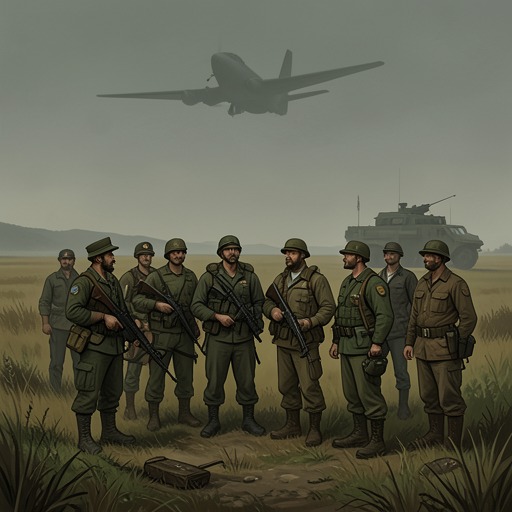
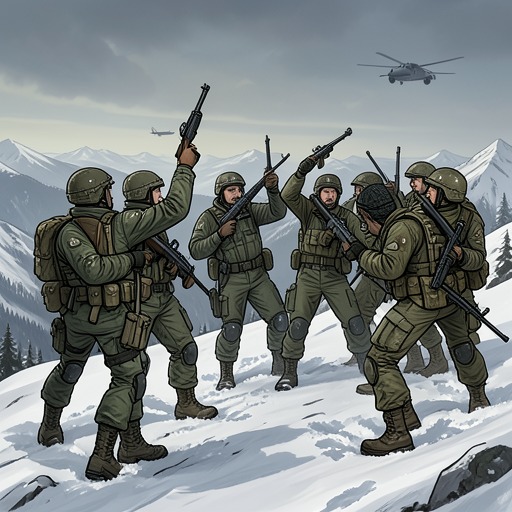
Júlíus’s team numbered about seventy men and women, travelling on skis, snowmobiles, and two tracked vehicles. Their luminous orange jackets made them conspicuous against the soldiers’ Arctic camouflage: the rescuers needed to be seen in the conditions in which they worked, while the troops were dressed to pass unseen. The soldiers arrived on snowmobiles with powerful headlamps, rifles slung over their backs, and halted together as if drawing a line across the snow. The two groups stopped about ten metres apart.
The rescue party was not arriving without cause. Júlíus had already seen two members of his team at the bottom of a crevasse, one dead and the other unlikely to survive. He believed the men in white camouflage were responsible for what appeared to be an accident. The rescuers were now responding to a distress signal from within the area the Americans claimed was prohibited. The soldiers’ effort to stop them therefore confronted Júlíus not only with an unexplained restriction but with the possibility that people still needed help.
The authorities had offered conflicting explanations for the military activity on the glacier. At an emergency meeting, American officials had insisted that nothing said behind closed doors should leave the room and explained their surveillance of Iceland’s borders by reference to the defence treaty. The general later told Icelandic ministers that an old German bomb on the glacier was being removed and that the rescue team faced danger. Yet a pilot asked to verify what his aircraft would transport was told that the plane contained no bomb. Separately, Vytautas Carr explained that a plane’s cargo was connected to the Walchensee gold, much of it acquired from concentration camps. These statements do not settle what the rescuers would encounter, but they establish the secrecy and competing claims surrounding the military operation.
Orders and Refusal
Júlíus left one of the tracked vehicles to speak to the soldiers. Their officer, whose face remained difficult to see behind goggles and scarf, told him that the rescue party had entered a U.S. military prohibited zone and that he had orders to prevent further movement. The officer said the restriction would not last long, but gave no details. Júlíus responded that the team had heard nothing about a prohibited zone and demanded to know what was happening, why one of his men had been killed, and what a plane on the glacier had to do with the secrecy.
Instead of answering, the officer ordered the rescuers to hand over their mobile phones, radios, walkie-talkies, and emergency flares. The demand would have stripped a rescue team of equipment essential to communication and emergency response just as it was answering a distress signal. The officer also insisted that there were no Icelanders in the area apart from the rescuers themselves. Júlíus rejected both the order and that denial: the team had come because Icelanders were in danger, and he maintained that no American military zone had been established on the glacier. He also suspected that a volcanic-eruption alert being used to explain events was fabricated.
The Attack
The officer remained calm as Júlíus asked whether the American army would shoot if the rescuers refused. Júlíus then told the soldiers that they had no right to stop the team or seize its equipment, and announced that they were continuing. The volunteers stood behind him without retreating. Their determination was set against the soldiers’ weapons and the authority the Americans claimed for their orders; the confrontation was at once about access to the glacier and about who could exercise power in Icelandic territory.
As Júlíus turned and walked back toward his team, he did not see the officer signal to a nearby soldier. That soldier removed his rifle, knelt, and fired a volley into the tracked vehicle ahead of Júlíus. Bullets riddled its grille and bonnet. Júlíus threw himself onto the ice as the engine caught fire; a small detonation sent the bonnet onto the vehicle’s roof. The people inside kicked open the doors, scrambled out, and crawled clear. The vehicle then went up in flames, lighting the winter darkness. The account describes fire directed at the vehicle, not a volley aimed at the rescuers themselves, and does not report anyone being killed in this particular attack.
Consequences and Significance
The shooting stopped quickly, but the soldiers immediately unslung their weapons and covered the rescue party. The officer repeated the demand for phones, radios, and flares in the same flat tone. Júlíus, who had never before encountered military force or seen weapons used in combat, stared at the burning wreckage and felt his anger give way, briefly, to trepidation about what might happen to his team. The rescue volunteers had arrived as rescuers; after the attack, they were also a group under armed guard, deprived of the safety their equipment could provide.
Nearby, Kristín and Steve were approaching the ice cap and saw lights ahead. They had expected close surveillance and did not try to outrun the snowmobiles that came to meet them. Kristín’s fear returned, and she relied on the fact that people who needed to know had already been informed of what was happening, though she could not know whether that would protect her. The account shifts from the burning vehicle and Júlíus’s confrontation to their interception, linking the assault on the rescue team to a wider effort to control movement around the glacier.
The scene’s central reversal is stark: an emergency response meets a military order, and refusal is answered not with explanation but with gunfire. The soldiers’ demand for the rescuers’ communications equipment and flares would have isolated them precisely where they believed people needed help. By showing a tracked vehicle torn open and burning beneath the glacier’s darkness, the episode gives physical consequence to the operation’s secrecy. It also makes the sovereignty dispute more than a matter of official protest: Júlíus and his team encounter the claimed boundary in the form of armed men, and the American order is enforced by destroying the means of their approach.